Heaven
Soul Guardian: A Hellishly Cozy FantasyHeaven is the celestial realm and governing order against which Hell defines itself, yet the novel repeatedly complicates that opposition. It is the source of angels, divine authority, and the promised destination of the redeemed, but it is also a political institution whose agents can misjudge, wage unnecessary wars, obstruct mercy, and exclude beings who no longer belong comfortably to either side. Heaven’s decisive significance lies in this contradiction: it claims absolute moral and cosmic authority while remaining vulnerable to bureaucracy, vanity, factionalism, and the consequences of its own rules.
Nature and Cosmic Position
Heaven exists across the black void between worlds as one of the powers capable of shaping the fate of Earth. The proposed apocalypse is not merely a demonic fantasy; it is a conflict involving Heaven, Hell, and the mortal realm, with the end of the world scheduled for Christmas Day after the inhabitants have opened their presents but before they discover that the batteries are missing. The conspirators’ discussion of fire, ice, or a flood treats apocalypse as a problem of execution, but the scale of the plan establishes Heaven as one of the forces whose intervention or failure can determine whether humanity survives.
The Great Flood supplies an earlier example of Heaven’s destructive reach and its limits. After the flood failed to destroy mankind, Metatron developed an irrational hatred of all things buoyant, making boats and even a bobber reminders of a failed attempt to finish the world. The episode turns a foundational act of biblical destruction into institutional embarrassment and personal grievance. Heaven is therefore associated not only with judgment, but with the historical record of judgments that did not achieve their intended result.
Heaven also functions as a destination whose promise is controlled by rules and tradition. Ganon-Sharoth, having forsaken Hell, believes he may still be denied entry to Heaven despite no longer accepting the realm to which demons are traditionally condemned. His predicament exposes a severe boundary in the cosmic order: moral transformation does not automatically create legal or theological belonging. Heaven can remain closed even to someone who rejects Hell, leaving the individual suspended between systems rather than welcomed into salvation.
Hierarchy, War, and Authority
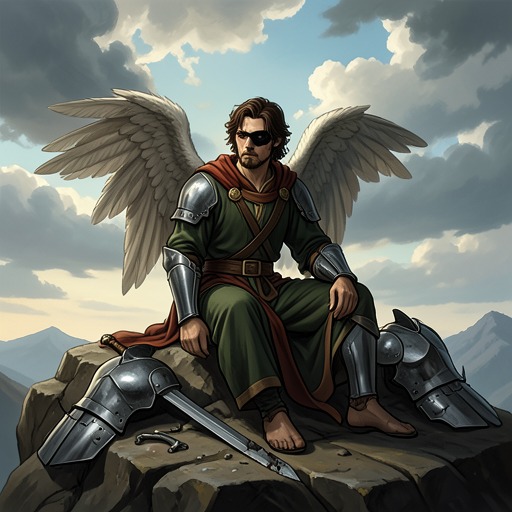
The angels of Heaven are not presented as a uniformly gentle or subtle host. Ordinary angels are described as comparatively easy for Bael-Sharoth to kill, while archangels are terrifying battlefield opponents, likened to tanks with wings. This distinction gives Heaven a military structure in which rank corresponds to overwhelming force. Its celestial identity is thus inseparable from organized violence, especially when its highest agents decide that divine interests must be defended through war.
The history of Lucifer’s rebellion reveals the deepest criticism of Heaven’s military order. Zephyr argues that the loyalists could have retreated to the inner sanctum and allowed God to decide what to do. Instead, Gabriel sent legions of angels into battle, sacrificing them in a conflict that, in Zephyr’s judgment, did not require such a defense. Because God was absolute and omnipotent, the need for battle belonged not to divine necessity but to Gabriel’s ego. Heaven’s war machine consequently appears as an institution that can convert loyalty into needless sacrifice while presenting the result as duty.
Gabriel’s conduct also shows how Heaven’s authority is personalized by ambitious officials. He interrogates Zephyr about whether Bael-Sharoth’s activities matter more than duties to Heaven, treating the adoption agency and the children in Zephyr’s care as distractions from celestial obedience. When Zephyr challenges the history of the war and accuses Gabriel of pursuing glory from a safe distance, Gabriel responds by lifting him from the ground by the throat. The scene makes Heaven’s hierarchy physically visible: questioning authority is answered not by discussion but by force.
Institutions and the Adoption of Six
Heaven’s institutional presence reaches into the mortal world through the Arms of the Angels Adoption Agency. Bael-Sharoth and Maharet Flameheart visit the agency because they need to arrange a future for Six, and Bael immediately notices the heavy-handed symbolism of its name. Maharet observes that angels are not known for subtlety, and the agency embodies that trait: Heaven’s charitable work is real, but it is wrapped in overt religious imagery and governed by an inflexible administrative culture.
Zephyr represents a competing interpretation of heavenly service. He runs the adoption agency and works to place children in good homes, while Gabriel regards those responsibilities as secondary to the demands of Heaven. Zephyr’s commitment is not abstract. He sees the children whose photographs decorate the agency’s walls and realizes that the impending apocalypse would erase the lives he has tried to protect. The possibility that Bael-Sharoth’s visit to Harrows is connected to Armageddon transforms the agency from a place of care into a threatened refuge, linking Heaven’s institutional mission to the survival of ordinary human futures.
The adoption case also reveals how heavenly-adjacent institutions can become entangled with records and legal identity. Zephyr discovers that Six had been officially recorded as having drowned two years earlier, a status that threatens any attempt to have her adopted. Maharet believes Mike arranged the false death record through a follower in the coroner’s office so that Six could be sacrificed whenever he wished. Heaven’s protective infrastructure therefore confronts a mortal bureaucracy corrupted by cult power, and the struggle to save Six requires more than supernatural strength: it requires correcting the official story of whether she is alive.
The Apocalypse and Heaven’s Bureaucratic Failure
Heaven is implicated in the planned Armageddon through Metatron’s involvement. Metatron meets Lucy Morningstar in the void between worlds to discuss how the apocalypse should begin, while Lucy conceals her own reasons for supporting the chosen plan. The meeting presents the end of the world as a conspiracy negotiated across the boundary between Heaven and Hell. Its danger comes not simply from raw power, but from the fact that celestial officials can cooperate with an old enemy while assuming that procedural details are merely formalities.
Once Gabriel learns the significance of Bael-Sharoth’s arrival at Harrows, Zephyr understands that the world is approaching catastrophe. He imagines the trumpets sounding, Heaven and Hell fighting across the smoking ruins of Earth, and the disappearance of everything from humans to familiar cultural pleasures. The fear is comic in its references to Doritos, Twinkies, R.E.M., and Pink Floyd, but the underlying consequence is absolute: Heaven’s celestial war would consume the mortal world that Zephyr has dedicated himself to preserving.
The plan is eventually canceled after Bael-Sharoth secures Lucy’s support. A divine memo declares that Metatron acted without authorization and orders the apocalypse stopped. This administrative reversal exposes both the reach and weakness of Heaven’s bureaucracy. A single official document can terminate an event intended to destroy the world, but the same system nearly allowed the unauthorized plan to proceed. Gabriel’s reaction makes the institutional stakes personal: he fears becoming a laughingstock and losing authority, so he considers destroying the memo rather than accepting the decision.
The paper’s refusal to burn turns bureaucracy into supernatural resistance. Gabriel may possess a flaming sword and the status of an archangel, but he cannot simply erase an order that invalidates his ambitions. Heaven’s authority is therefore represented through paperwork as much as through weapons or miracles. Its procedures can prevent apocalypse, yet they can also become objects of manipulation by officials who value reputation and glory over obedience.
Boundaries, Judgment, and Narrative Significance
Heaven’s relationship with Hell is defined by opposition, but the novel’s most revealing cases occur at the boundary between the two realms. Bael-Sharoth is a baron of Hell who repeatedly crosses into the mortal world, negotiates with celestial figures, and seeks protection for his family. Ganon-Sharoth’s rejection of Hell further demonstrates that the cosmic division is not psychologically or morally simple. A demon can condemn the system that formed him, while Heaven can remain unwilling to receive him.
The boundary becomes absolute and terrifying in Gabriel’s death. Bael-Sharoth invokes his right as a baron of Hell to banish Gabriel from the infernal realm and all associated territories before killing him with a holy sword. Gabriel’s soul cannot return to Heaven, but it is also barred from Hell; even purgatory is unavailable because it lies on the outer fringes of the infernal realm. The result is not a conventional passage from life to afterlife but exclusion from every recognized destination. His soul is trapped between dimensions and begins to unravel through unprotected contact with the void.
This fate clarifies Heaven’s larger role in the novel. The realm represents salvation, but access to it is regulated by allegiance, history, and institutional judgment rather than by a simple measure of present intention. Its angels may protect children, administer adoption, or cancel an unauthorized apocalypse, yet they may also send soldiers to die, defend pride as duty, and leave repentant or displaced beings without a home. Heaven is consequently neither a pure counterweight to Hell nor merely its opposite setting. It is one half of a damaged cosmic order whose categories of loyalty, sin, redemption, and belonging repeatedly fail to contain the characters who cross them.